Content
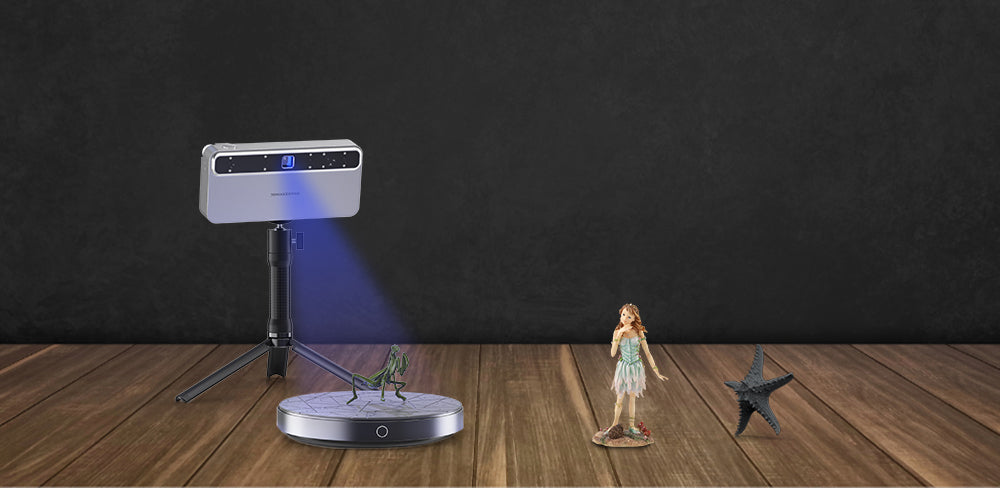
In ideal settings -- good lighting, neutral colored surfaces, and plenty of room to maneuver-- many 3D scanners will deliver acceptable results. However, most real-world scanning tasks take place in far less forgiving environments: dimly lit workshops, industrial floors, tight cavities, and on objects with challenging surface colors. Ordinary scanners tend to perform well only in “normal” conditions and often fail or deliver noisy data when moved beyond that comfort zone. The 3DMakerpro Toucan breaks through these limitations with advanced phase-shifting structured light, robust hardware, and intelligent design, maintaining reliable performance across a wide range of challenging scenarios.
a) Low-Light Environments
Conventional scanners rely on clear pattern projection and strong contrast between structured light and ambient illumination. In low light or uneven lighting, the projected pattern becomes harder to detect, leading to increased noise, unstable tracking, and holes in the 3D model. Operators often compensate by adding external lights or repeating scans, which slows down the workflow and adds frustration, especially in workshops, factories, or on-site tasks.
Toucan’s high-power blue structured light system, with dual power modes (eye-safe Class 1 and higher-output Class 3R), preserves structured light visibility even in dim conditions. This means it maintains stable tracking and cleaner raw data without additional lighting. Combined with a working distance range of 200–1000 mm and a scan speed of up to 15 fps, Toucan captures consistent data in low light with fewer rescans needed.
b) Scanning Black and Dark Surfaces
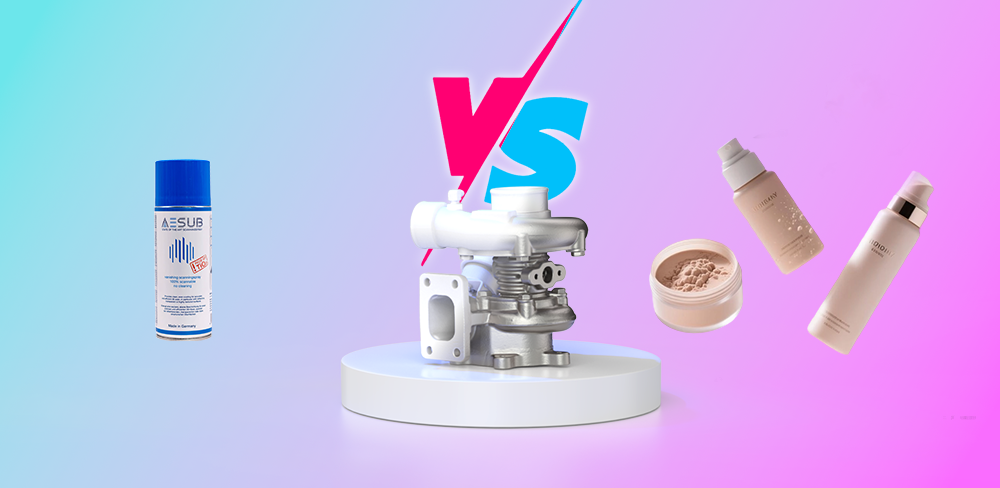
Dark, matte, or low-reflective surfaces are a notorious challenge. Ordinary scanners typically struggle to capture sufficient reflected light from black or dark objects, resulting in incomplete scans, fragmented geometry, or severe holes. Users often resort to surface preparation, such as scanning sprays, which adds time, cost, and steps to the workflow.
Toucan improves light return efficiency on low-reflective surfaces through optimized phase-shifting structured light and enhanced optics. With single-frame accuracy of up to ≤ 0.03 mm in near-range captures and reliable resolution (≤ 0.05 mm in small mode), Toucan delivers more complete data on dark surfaces without requiring extensive preparation, helping users achieve high-quality scans of black plastics, metals, and coatings.
c) Scanning Red and Highly Saturated Colors
Highly saturated colors, especially red, can interfere with structured-light systems because many scanners struggle to interpret pattern reflections accurately on these surfaces. This often leads to distortion, tracking breaks, or uneven geometry, particularly problematic for industrial parts, automotive components, or art pieces with strong color.
Toucan’s calibrated optical system, combined with a high-resolution 48 MP RGB camera and multiple 3D cameras, enhances color and geometry capture. By relying on phase information rather than brightness alone, Toucan reduces color-related distortions and maintains reliable geometric accuracy when scanning red or vibrant surfaces. This capability broadens the range of materials and objects that can be scanned successfully.
d) Tight Spaces and Complex Geometry
Scanning internal cavities, narrow recesses, and tightly packed assemblies presents significant challenges for ordinary systems. Occluded angles often cause tracking loss and alignment drift, which in turn create holes, overlaps, or misaligned data. Standard workflows can stall when the scanner loses positional context due to occlusion.
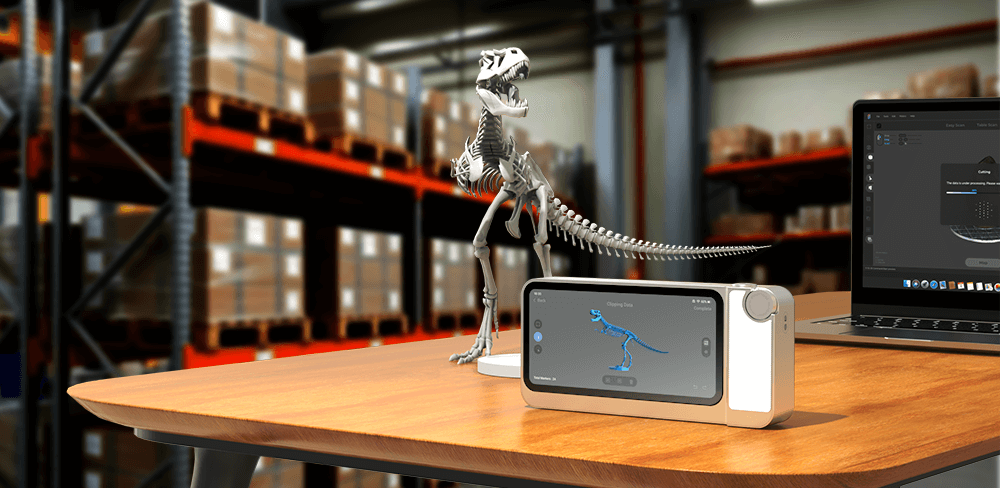
Toucan’s tracking algorithms and multi-camera system maintain alignment even when features disappear temporarily from view. Its flexible scanning modes, handheld, photo, and table scan, allow users to choose the best approach for the object at hand. With a field of view up to 1000×750 mm in large mode, Toucan can also handle bigger structures after capturing smaller, occluded regions without losing continuity.
e) Scanning Thin Edges and Small Objects
Thin structures and small components present a major challenge for many conventional scanners. Single-frame coded systems often struggle to capture narrow edges, sharp corners, and fine features with sufficient stability. When scanning thin sheet metal, blades, wires, small mechanical parts, or delicate models, ordinary scanners may produce broken edges, incomplete surfaces, or distorted geometry. Fine details can appear fragmented or entirely missing, forcing users to rescan repeatedly or manually repair the mesh during post-processing.
Toucan is specifically designed to improve accuracy in these demanding scenarios. Its dual-lens imaging system generates each frame of point cloud data from seven images, significantly increasing data density and geometric reliability. Compared to traditional single-frame coded scanners, this multi-image synthesis approach enhances edge definition and detail preservation, allowing thin and small objects to be captured more accurately and consistently. In addition, Toucan supports both near-range and far-range scanning modes. The near-range mode (135 x 185 mm single-frame range) is optimized for capturing fine details and small objects with high precision, while the far-range mode (1000 x 750 mm single-frame range) enables efficient scanning of larger surfaces without sacrificing alignment stability. This flexibility ensures cleaner edges, stronger structural integrity, and more dependable results across different object sizes.
Consistent Results Beyond Normal Conditions
Most 3D scanners deliver acceptable performance only in controlled environments and with friendly surface conditions. In contrast, Toucan’s combination of advanced optical design, phase-shifting light projection, and powerful onboard processing ensures high precision and consistent scanning in low light, on dark surfaces, with saturated colors, and in tight or complex spaces. With a wide scanning range (10×10×10 mm up to 4000×4000×4000 mm) and versatile operational modes, Toucan lets professionals and makers alike extend their scanning workflows far beyond what’s possible with ordinary systems.


Featured collection
All-in-onePhase-Shifting TechPre-order
Carrying Case for Toucan