



Content

In the context of 3D reality capture, a point cloud is more than just a collection of data—it is a direct digital translation of the physical world. Whether you are scanning a small object on a desk or capturing an entire building, the underlying output is the same: millions of spatial points that collectively describe real-world geometry. However, the way these point clouds are generated, processed, and ultimately used varies significantly depending on scale.
Understanding Point Clouds: From Visual Data to Measurable Reality
At its core, a point cloud is a set of coordinates in three-dimensional space. Each point contains X, Y, and Z values, and often additional attributes such as color (RGB) or reflectivity. Unlike images, which only represent surfaces visually, point clouds encode measurable geometry—making them not just visual assets, but analytical ones.
This distinction is critical. A point cloud doesn’t just show what something looks like; it allows you to measure it, analyze it, and rebuild it digitally. In most workflows, point clouds are not the final output—they serve as the foundation for downstream processes such as mesh reconstruction, CAD modeling, and digital twin creation.
It is also important to note that a point cloud is not yet a surface. To become usable in design or manufacturing workflows, it often needs to be converted into a mesh—a continuous surface representation. This step is especially important in object-based applications, where surface accuracy directly impacts the final result.
Object Point Clouds: When Precision Defines Value
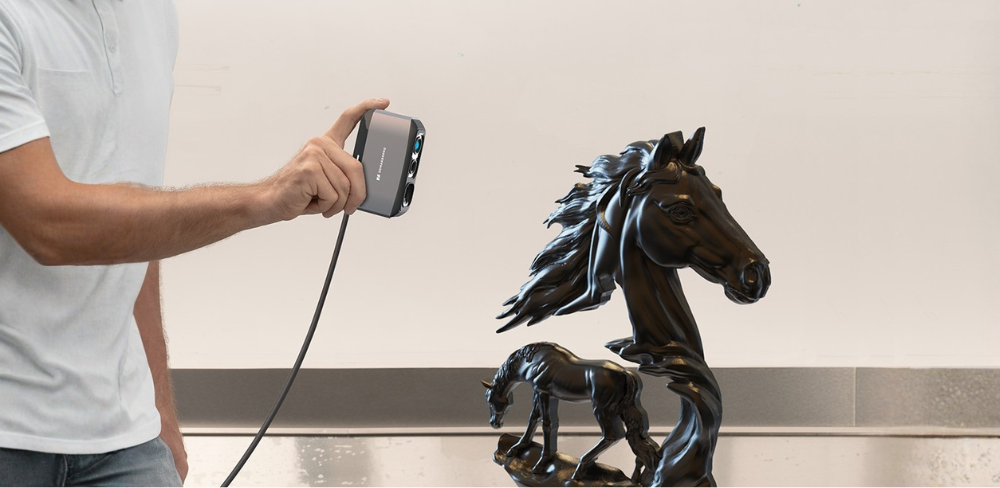
When scanning objects—such as mechanical parts, sculptures, or consumer products—the priority is capturing extremely fine surface detail. Technologies like structured light or phase-shift scanning project controlled patterns onto surfaces, generating highly dense point clouds with tightly packed data points. This level of density is essential, because accurate surface reconstruction depends on capturing even the smallest geometric variations.
This density enables millimeter-level—and in some cases micrometer-level—accuracy. As a result, object-based point clouds are widely used in scenarios where precision directly impacts outcomes. In manufacturing, they support reverse engineering and quality inspection. In healthcare, they enable custom prosthetics and orthotics. In cultural preservation, they digitally archive artifacts with high fidelity.
In these applications, the point cloud functions as a precise “digital mold,” preserving every curve, edge, and imperfection in a way that traditional methods cannot match.

Space Point Clouds: When Structure Defines Understanding
When the focus shifts to larger environments—such as homes, construction sites, or outdoor spaces—the role of the point cloud changes. Instead of fine surface detail, the priority becomes spatial relationships and structural accuracy.
LiDAR-based systems measure distances across wide areas, producing point clouds that capture how elements relate within a space: wall alignment, room layout, ceiling height, and object positioning. In this context, spatial relationships matter more than surface detail, which is why point density can be lower while still maintaining practical usability.
While the precision is typically at the centimeter level, the scale is vastly larger, and the datasets are significantly heavier. These point clouds are essential in industries where understanding space is critical. In architecture, engineering, and construction (AEC), they enable accurate site documentation and renovation planning. In real estate, they power immersive digital twins. In robotics and autonomous systems, they provide machines with spatial awareness for navigation.
Here, the point cloud acts as a stable “spatial framework,” allowing entire environments to be measured, analyzed, and interacted with digitally.

Why Point Clouds Matter: From Detail to Decision-Making
The true value of point clouds lies in their ability to represent reality as it actually exists—not as it was designed or assumed. Traditional drawings often reflect ideal conditions, but point clouds capture real-world deviations, imperfections, and changes over time.
More importantly, point clouds act as the starting point for a broader digital workflow. Once captured, they can be processed into meshes for design and manufacturing, integrated into CAD or BIM systems, or used to build digital twins for simulation and analysis.
This makes them uniquely powerful across different scales. For objects, they enable precise replication, inspection, and optimization. For spaces, they support better planning, coordination, and long-term asset management.
In both cases, point clouds replace guesswork with data-driven accuracy—providing a reliable foundation for decision-making.
Choosing the Right Approach: Precision vs. Scale
Ultimately, the difference between object and space point clouds comes down to precision versus scale. Object scanning focuses on micro-level detail within controlled volumes, where high point density is required for accurate surface reconstruction. Space scanning captures macro-level structure across large environments, where spatial consistency and coverage are more important than ultra-fine detail.
Rather than competing, these approaches complement each other. Together, they form a complete toolkit for digitizing reality—whether you are reconstructing a single component or mapping an entire environment.
JM Studio for Object Scanning
JM Studio is a dedicated processing platform designed for high-precision 3D scanning workflows using 3DMakerpro structured light and phase-shift technologies. It integrates data capture, real-time preview, point cloud processing, and texture mapping into a unified pipeline, allowing users to efficiently convert raw scan data into accurate, editable 3D models. With support for formats such as OBJ, STL, PLY, and ASC, JM Studio ensures seamless compatibility with downstream CAD, design, and inspection workflows.
Because object point clouds rely on extremely high density for accurate surface reconstruction, processing quality directly affects the final result. JM Studio is designed to preserve fine geometric detail while enabling precise alignment and reconstruction, making it ideal for applications such as reverse engineering, product development, quality inspection, and cultural heritage preservation.

Ray Studio for Spatial Scanning
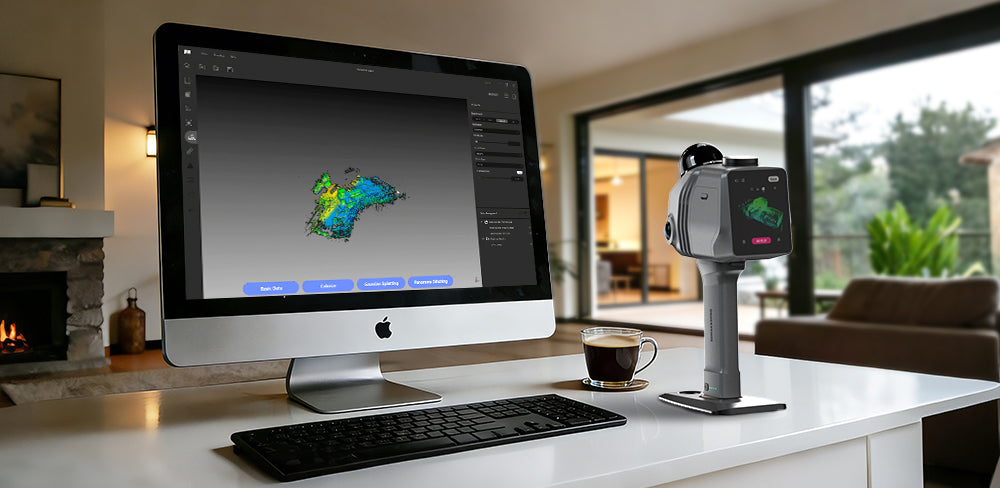
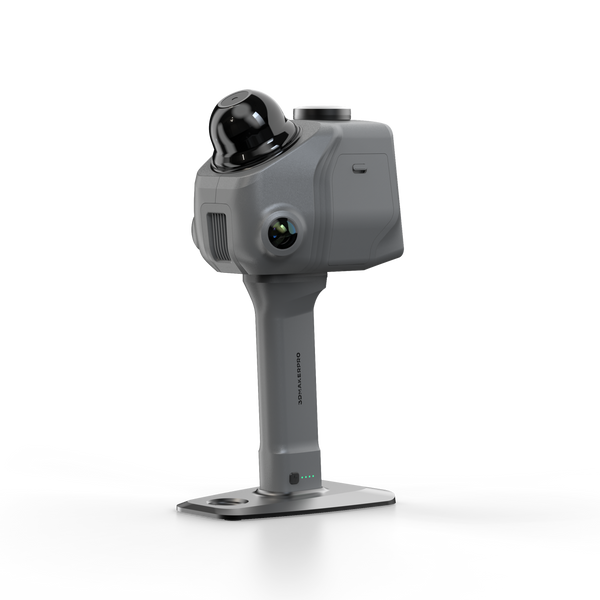
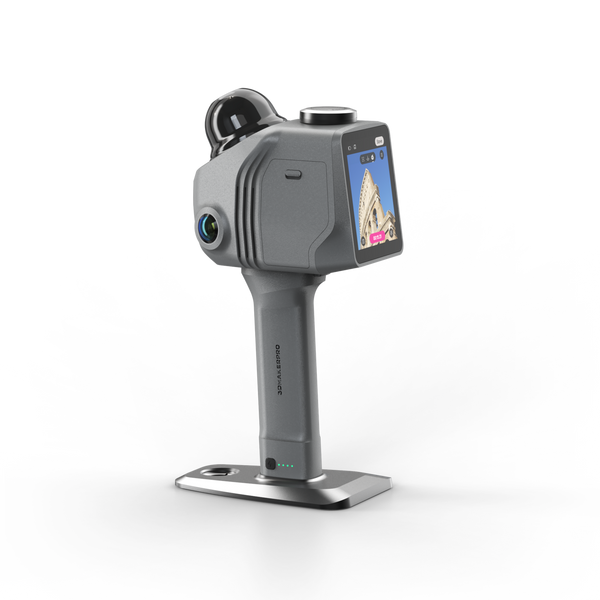
Ray Studio is a dedicated processing platform for LiDAR spatial scanning, engineered to efficiently manage large-scale point cloud datasets. It supports automated and semi-automated workflows—including stitching, denoising, and filtering—to convert raw scan data into clean, structured spatial outputs. Specifically optimized for the 3DMakerpro ecosystem, it supports devices such as Eagle, Hawk, and Raven, as well as future 3DMakerpro LiDAR spatial scanners, ensuring stable and reliable performance across diverse environments. To facilitate seamless integration, Ray Studio enables data export in multiple industry-standard formats, including LAS, PCD, PLY, OBJ, E57, and XYZ.
Given that spatial point clouds require massive alignment and structural integrity, processing efficiency is critical. Ray Studio addresses this by optimizing the management of large datasets and supporting colorized point clouds for enhanced visual interpretation. Additionally, it features Gaussian Splatting capabilities to generate smooth, immersive 3D visualizations from spatial data. These advanced features make it highly effective for professional applications such as architecture, construction, real estate visualization, and digital twin development.

In the End
A point cloud is not the end of the workflow—it’s the beginning of it. What you capture is more than just data; it’s a reliable digital foundation that can be shaped, refined, and transformed to fit your goals.
Once processed, point cloud data can flow into a wide range of applications, from modeling and analysis to simulation and visualization. It enables more accurate decisions, more efficient workflows, and more scalable outcomes. In this sense, capturing a point cloud is not just about recording reality—it’s about unlocking what comes next, and building a stronger foundation for everything that follows.

Featured collection
LiDAR scanner
Raven LiDAR Scanner
All-in-onePhase-Shifting TechPre-order
Medium-format


