



Content
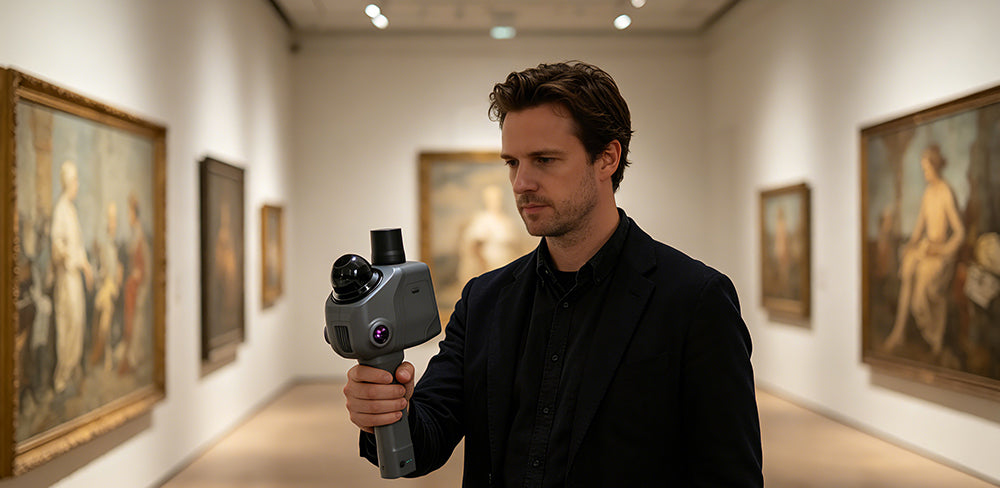
We’ve long relied on photographs to capture the beauty of art exhibitions. They freeze moments, preserve details, and help us remember what we’ve seen. But photos are, by nature, limited. They capture fragments—angles chosen by the photographer, moments in time, pieces of a larger spatial story. What they cannot fully convey is how an exhibition feels to move through, how artworks relate to each other, or how space shapes perception.
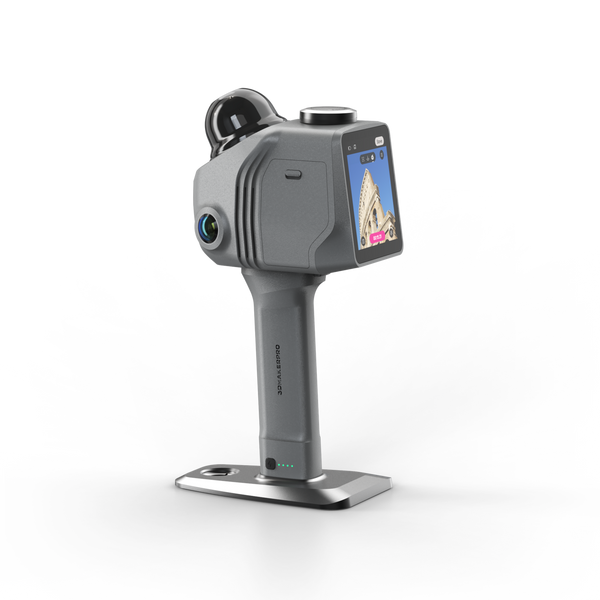
With the 3DMakerpro Raven LiDAR Scanner, this limitation begins to disappear. As a handheld LiDAR scanner, it captures the full environment—geometry, depth, and context—in a single workflow. Combined with technologies like Gaussian splatting, exhibitions can be reconstructed as immersive digital spaces. Designers can plan within them, curators can refine layouts, and even visitors can revisit exhibitions long after they’ve ended. In this shift, space is no longer just recorded—it becomes something that can be explored, analyzed, and designed.
From Images to Spatial Understanding
Traditional documentation methods often require hundreds of photos to represent a single exhibition. Even then, the result is still incomplete. Important spatial relationships—distances between works, sightlines, or the flow of movement—remain difficult to interpret.
With the 3DMakerpro Raven LiDAR Scanner, a single scan using a 3D LiDAR scanner can generate a complete spatial model of the environment. Thanks to its 360° × 40° field of view and a scanning range of up to 100 meters, even large exhibition spaces can be captured efficiently with minimal blind spots. A medium-sized gallery can typically be scanned in just 10–20 minutes, depending on the complexity of the site.
More importantly, the result is not just visual—it is measurable. With an accuracy of up to 2 cm at 10 meters and a capture rate of 150,000 points per second, every wall, pathway, and spatial relationship is recorded as reliable data. This is where a handheld LiDAR scanner like Raven stands out—delivering both mobility and precision in a single device.

Painting Exhibitions: Precision and Color Harmony
In painting exhibitions, subtle spatial decisions have a significant impact on the viewing experience. The distance between artworks, their alignment on walls, and the viewer’s position all influence how each piece is perceived. Even slight inconsistencies can disrupt the rhythm of a gallery.
The 3DMakerpro Raven LiDAR Scanner brings a high level of precision into this process, allowing curators to plan layouts with confidence. Instead of manually measuring and repeatedly adjusting positions, they can rely on a complete digital model generated by a 3D LiDAR scanner, where spacing and alignment are already accurate.
Color is equally critical. With its built-in 12 MP RGB camera capable of 4K texture capture, Raven preserves realistic visual information alongside spatial data. This allows designers to evaluate how artworks interact within the space—whether tones complement each other, how lighting influences perception, and whether the overall visual flow feels balanced. Compared to walking through a gallery and taking notes, a full-color 3D model makes these relationships immediately visible and far easier to refine.

Sculpture and Installation Art: Scale and Spatial Freedom
For sculpture exhibitions and large-scale installations, the challenge shifts from precision on a wall to understanding space in three dimensions. These works often extend into the environment, interacting with architecture and requiring careful planning of scale, positioning, and visitor movement.
Here, Raven’s long scanning range becomes especially valuable. As a 3D LiDAR scanner capable of capturing spaces up to 100 meters, it allows large halls, open venues, and even outdoor environments to be digitized in a single workflow. At the same time, its high-density point cloud ensures that structural details are preserved, enabling accurate reconstruction of both the environment and the artworks within it.
This makes it easier to experiment with placement, test how installations occupy space, and design how visitors will move through the exhibition. Instead of relying on rough estimates, teams can work within a complete and measurable spatial framework.

Reliable Capture in Any Lighting Condition
Exhibition environments are not always well-lit. Many installation spaces use controlled or low lighting to create atmosphere, and setup often takes place before lighting systems are fully configured.
Unlike traditional imaging methods, LiDAR scanning is not dependent on ambient light. The 3DMakerpro Raven LiDAR Scanner, as a portable handheld LiDAR scanner, maintains stable performance even in low-light conditions, continuing to capture accurate spatial data where cameras alone would struggle. This ensures that scanning can be carried out at any stage—during setup, adjustment, or final presentation—without being limited by lighting conditions.
Combined with its RGB capture capabilities, Raven still preserves visual context wherever lighting is available, delivering both structure and appearance in a single dataset.
From Planning to Exhibition to Review
One of the key advantages of LiDAR-based workflows is that they extend beyond a single stage of the exhibition process.
Before installation, spatial models allow curators and designers to test layouts, refine positioning, and make informed decisions. During the exhibition, the scanned model can be used for digital showcases or remote viewing experiences, offering something far more immersive than traditional photography.
After the exhibition, the same data becomes a valuable asset for review and archiving. Instead of relying on hundreds of photos, teams can revisit the entire space through a single, complete 3D model generated by a 3D LiDAR scanner—preserving not just images, but the full spatial experience.

Efficiency That Scales with Creativity
Capturing an exhibition with traditional methods often means taking hundreds—or even thousands—of photos, followed by time-consuming organization and interpretation. Even then, the result remains fragmented.
With the 3DMakerpro Raven LiDAR Scanner, the process is streamlined into a single, efficient workflow. A space can be scanned in minutes, producing a complete dataset that can be shared across teams. With a swappable battery system supporting extended operation (up to around 2 hours per battery), this handheld LiDAR scanner allows continuous scanning without interruption, even in larger venues.
This efficiency reduces the need for repeated site visits and manual re-measurement. More importantly, it allows teams to focus less on logistics and more on creative decisions—making it easier to design exhibitions that are both precise and expressive.
In the Future
As art exhibitions continue to evolve toward more immersive and spatially complex experiences, the tools used to plan them must evolve as well. Moving from photographs to full 3D spatial models represents a fundamental shift—from documenting spaces to truly understanding and shaping them.
With its combination of high accuracy, long-range scanning, dense data capture, and strong color reconstruction, the 3DMakerpro Raven LiDAR Scanner stands out as a powerful 3D LiDAR scanner for modern exhibition workflows. It allows artists and curators not only to capture space, but to work within it—turning every exhibition into something that can be explored, refined, and remembered in its entirety.

Featured collection
LiDAR scanner
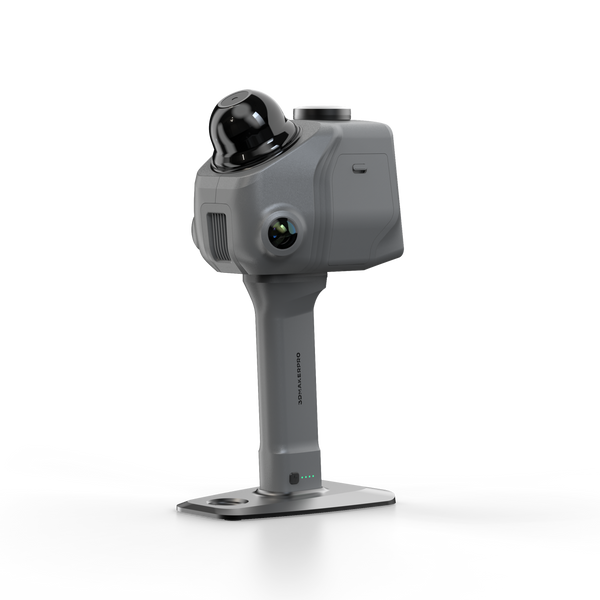
Raven LiDAR Scanner


Battery Grip


