Content
Listening to the Silent Language of Trees
Forests have always been rich with information, quietly recording time through growth, texture, and form. Every tree reflects its environment—shaped by light, wind, water, and years of adaptation. From the roughness of bark to the rhythm of its growth, these details form a natural record that has long fascinated researchers and creators alike.
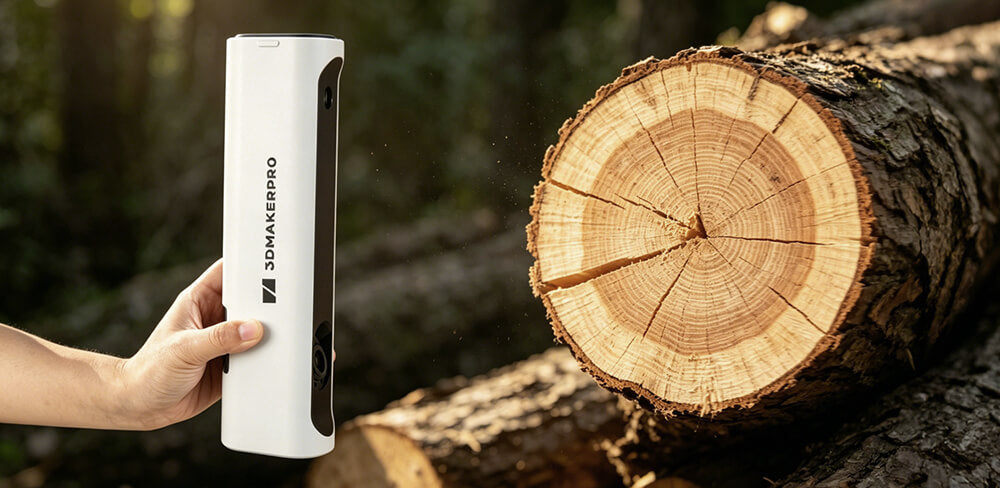
Today, with tools like the 3DMakerpro Lynx 3D Scanner, these subtle characteristics can be captured and explored in entirely new ways. As a structured light 3D scanner, Lynx brings precision and clarity to organic forms, turning trees into detailed, analyzable 3D data.

Reading Tree Geometry in Three Dimensions
At a glance, a tree may appear simple. But in reality, it is a highly complex structure shaped over time. Slight curves in the trunk can indicate years of environmental pressure, while branching patterns reflect how a tree competes for light and space.
With a structure light 3D scanner, these details can be captured with remarkable accuracy. Lynx offers up to 0.10 mm precision, making it possible to record fine surface features such as bark ridges, cracks, and subtle deformations. What was once visual observation becomes measurable geometry—allowing users to study trees from a completely new perspective.
Capturing the Story Within the Wood
Some of the most compelling information a tree holds lies within its growth patterns. When wood is naturally revealed—through tree stumps or fallen trunks—these surfaces offer a direct view into the tree’s history.
A structured light 3D scanner like Lynx can capture these exposed sections in high detail, preserving the spacing and variation of growth rings with a resolution of around 0.30 mm. Once digitized, these patterns can be examined, compared, and archived without loss of detail.
This approach transforms physical wood into lasting digital records, making it easier to study changes over time or build reference datasets for environmental analysis.

A Tool That Adapts to Natural Objects
Trees are rarely uniform. Their shapes vary, surfaces are irregular, and sizes can range significantly even within a single subject. Lynx is built to handle this kind of variation with ease.
With a single capture range of 250 x 400 mm, it efficiently records sections of a tree’s surface, while supporting object sizes from 100 mm to 2000 mm. This makes it suitable for scanning anything from smaller branches to larger trunk segments.
As a structure light scanner focused on object detail, it allows users to move naturally around the subject, building up a complete 3D model step by step. The result is a smooth workflow that aligns well with the organic complexity of natural forms.
Reading Tree Surfaces as Living Data
Beyond internal patterns, the surface of a tree is equally informative. Bark carries distinct textures influenced by species, age, and environmental conditions. These patterns are not only visually rich, but also structurally meaningful.
Using a structured-light 3D scanning workflow, Lynx captures these textures with high fidelity. It utilizes NIR (near-infrared) light, a safe and non-invasive light source, making it suitable for scanning natural objects without affecting their surface. This allows users to work confidently in close proximity to organic materials while preserving fine details.
With this level of precision, it becomes possible to analyze bark morphology, monitor surface changes, or even support classification based on texture characteristics. A structured light 3D scanner turns these natural details into usable data—opening new possibilities for both scientific study and digital creation.

From Ecology to Creative Exploration
Digitizing trees at this level of detail unlocks a wide range of applications. In research, accurate 3D models can support growth analysis, structural assessment, and environmental monitoring. Over time, repeated scans can even reveal subtle changes that might otherwise go unnoticed.
At the same time, designers and artists can use this data as a foundation for creative work. The organic complexity captured through a structure light 3D scanner can be transformed into digital assets for animation, gaming, or generative design—bridging the gap between nature and technology.
A New Relationship with Nature
Capturing a tree in 3D is more than documentation—it’s a new way of understanding. Instead of relying solely on observation, we can now interact with nature through data, exploring form, structure, and detail with precision.
The 3DMakerpro Lynx 3D Scanner makes this possible by translating real-world objects into digital models that can be revisited and reinterpreted. It allows us to see trees not just as part of a landscape, but as individual structures full of information.

Featured collection
Large-formatSold out
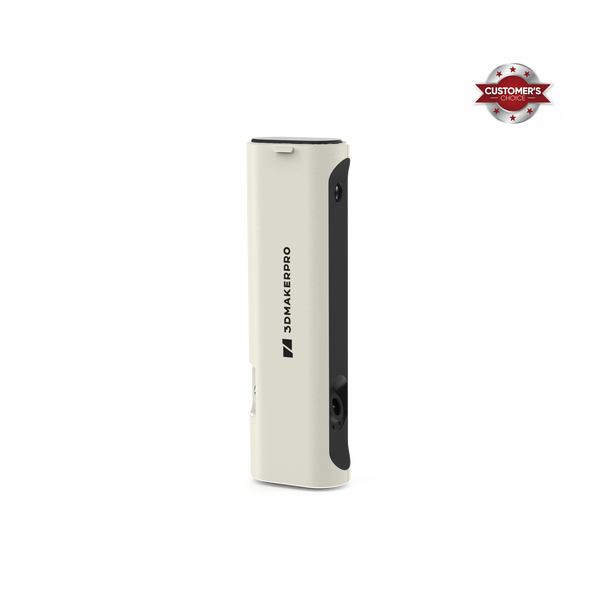

Lynx 3D Scanner